![]() |
||||||||
![]() |
![]() |
|||||||
|
13 Claims in New Mexico (L155) Asking price $500,000 or will lease for 10% Net Smelter Returns will consider Joint Venture
more claims available near paved road |
||||||||
![]() |
||||||||
|
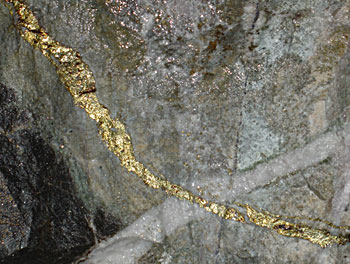
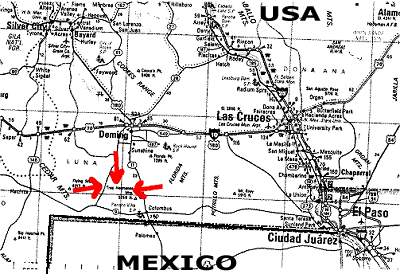
Thirteen mining claims in the Tres Hermanas Mining District near Deming, New Mexico.This well-known mining district is located two miles from a major paved highway between Deming and Columbus, New Mexico. These gold, silver, lead, zinc, and other minerals claims are located on B.L.M. land and have been in the present owner's possession since 1965. The claims are sixty five miles from the nearest smelter in El Paso, Texas. This property has a gold vein underlying the claims. This vein is 300 feet at the widest point and 75 feet at the narrowest point. It is over 1 mile in length. The vein lies in the contact zone between the granite and limestone formations, and was located by a successful and proven method used for centuries: dowsing with a gold nugget. The Tres Hermanes property has great potential as a gold and silver prospect worth millions. Core drilling will be required. Geology The Tres Hermanas Mountain consist predominantly of a quartz monzonite stock, dated as 50.3+2.6 Ma (hornblende, K-Ar; Leonard, 1982) and are surrounded by a thick sequence of predominantly Paleozoic and Cretaceous sedimentary rocks and Tertiary volcanic rocks (Balk, 1961; Griswold, 1961; Leonard, 1982). Thrust faults are common, in the West Lime Hills, Permian rocks are thrusted over Lower Cretaceous rocks (Drewes, 1991a). Many of the Paleozoic limestones have been metamorphosed by the quartz monzonite (Homme, 1958; Homme and Rosenzweig, 1970). A chemical variation with time from older metaluminous andesites, dacites, and rhyolites to younger alkaline rhyolite and latite occurs in the calc-alkaline rocks in the Tres Hermanas Mountains (Leonard, 1982). Mineral Deposits Three types of deposits occur in the district: Laramide veins and Laramide skarn. The age of the mineral deposits in Tertiary; they most likely formed after intrusion of the quartz monzonite but prior to intrusion of the basaltic dikes (Griswold, 1961; Doraibabu and Proctor, 1973). Geochemical data are consistent with a source of mineralization from the quartz mozonite, although locally the older bedrock may have contributed metals (Doraibabu and Proctor, 1973). Multiple periods of mineralization are likely, because of the variations in mineralization styles and alteration. The most productive deposits are the Laramide skarns, which occur in the Escabosa Limestone (Mississippian), and overlying Pennsylvanian sedimentary rocks. The replacement deposits are tabular to pod-shaped and are controlled by fractures and faults, which trend east-west and north-south. Silicification is common near these deposits (Griswold, 1961). Ore minerals consist predominantly of sphalerite, galena, chalcopyrite, willemite, smithsonite, and other oxidized lead-zinc minerals in a gangue of calcite, quartz, pyrite, and calc-silicate minerals (Wade, 1913; Homme and Rosenwieg, 1970). Ore at the Mahoney mine averaged 26.7% Pb, 34.5% Zn, and 5.0 oz/short ton Ag. Gold assays range as high as 1,500 ppb Au (Griswold et al., 1989). The Mahaoney and Lindy Ann mines are the largest producers. Skarns are locally common in the limestone xenoliths and limestones adjacent to the stock. Scheelite is reported in a tactite near South Park (Griswold, 1961). Fissure veins in quartz monzonite contain galena, willemite, smithsonite, and hydrozincite, and samples assayed 29-37% Zn, 11-40% Pb, and 2 oz/short ton Ag (Lindgren, 1909). Veins also occur along faults and fractures in Paleozoic sedimentary clastic rocks, quartz monzonite, and Tertiary volcanic rocks. The most productive veins, such as the Cincinnati, trend east-west; the north-trending veins have been less productive (Table 43; Doraibabu and Proctor, 1973). The Cincinnati vein strikes N75°E, dips 75-80°S, and is 10,000 ft long. Most veins are less than 4 ft wide. Disseminated pyrtie, chalcopyrite, sphalerite, and galena occur sporadically throughout the quartz monzonite stock, suggesting the potential for a porphyry copper and/or copper-molybdenum deposit; although the stock is not extensively altered as typical porphyry copper deposits. However, drilling in the stock has failed to reveal any economic concentrations (Griswold, 1961; NMBMMR file data). Most of the mines in the Tres Hermanas district are shallow; only a few reach depths of 300 - 500 ft. None of the deposits have been explored at greater depths, especially in the Mahoney and Cincinnati mines (Groswold, 1961). Areas of pyrite disseminations need examinations, for example secs. 26, 27, T27S, R9W. Where alluvium covers the extensions of these deposits is also favorable, but requires drilling. Anomalous concentrations of As, Ba, Be, Co, Cd, La, Mn, Mo, Pb, Sb, Th, Ti, Y, and Zn are found in stream-sediment samples from the area. To receive more information please email us and ask about the 13 Claims L155
fax (208) 265 5377
|
||||||||